
Expert guidance and done-for-you tools from an experienced neurodivergent clinician, so you can confidently offer customized, thorough ADHD assessments in your own practice.
And diversify your income while you're at it.
Everything a mental health therapist needs to run a full adult ADHD assessment, structured session by session.
I didn't realize it when I first started assessing, but running a full assessment requires some solid executive function effort!
I've taken the assessment process from my own practice and the organizational systems I built to keep myself on track, and distilled them into a compact, self-paced course that walks you through it step by step, pointing out pitfalls and explaining why each piece matters.
Confidently conduct a holistic assessment designed to keep high-maskers and late-identified adults from falling through the cracks.
The kit offers a diagnostic track that is rigorous enough to stand up to scrutiny, and a neuroprofile track for clients who really just want some deeper answers and clarity.
For clinicians whose scope includes diagnosis, and who want to do it.
The full process, built so the letter you write at the end holds up when a prescriber or an employer reads it.
A similar process that helps you construct a detailed picture of your client's strengths and challenges, rather than a diagnosis. For some clinicians and clients, this is exactly what's needed.
If you're not sure which one is for you, I'll walk you through it in the first module.

I'm a neurodivergent, late-diagnosed ADHD therapist, and I work with ADHD adults on two levels: practical strategies for everyday challenges, and the slower healing and self-acceptance that so often comes on the heels of a late diagnosis.
My focus is high-masking adults who, like me, spent years being told they were too anxious, or full of potential they somehow never quite reached after high school. That's why I built this process to catch the people who most often get missed: high-maskers, high-achievers, and women whose ADHD never matched the screeners.
This is the process I use in my own practice, refined through real assessments and developed with the support of clinical supervisors and colleagues experienced in assessment. Whether your brain is neurodivergent or not, I want it to feel like a relief, because assessment shouldn't cost you a month of executive function.
Lacey Redding, LMHCA · Sound Mind Seattle & Sound Mind Europe · Telehealth
(just a quick hello from the human behind the kit)
The kit walks alongside you step by step, giving you what you need at the moment you need it.
Actual pages from the kit, all downloadable and yours to use forever.
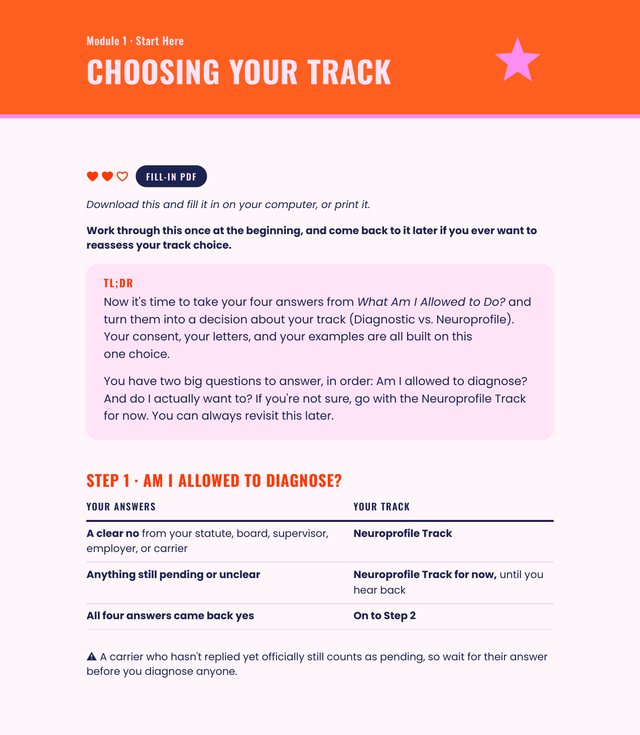
A short worksheet that takes your scope check and turns it into a clear decision about which track will fit best.
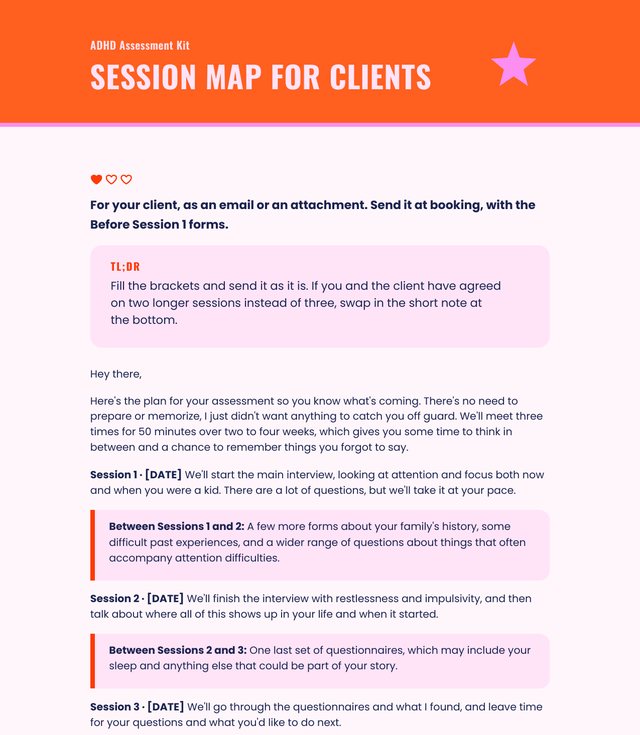
A ready-to-send note to give your client more certainty and clarity as they head into the assessment process.
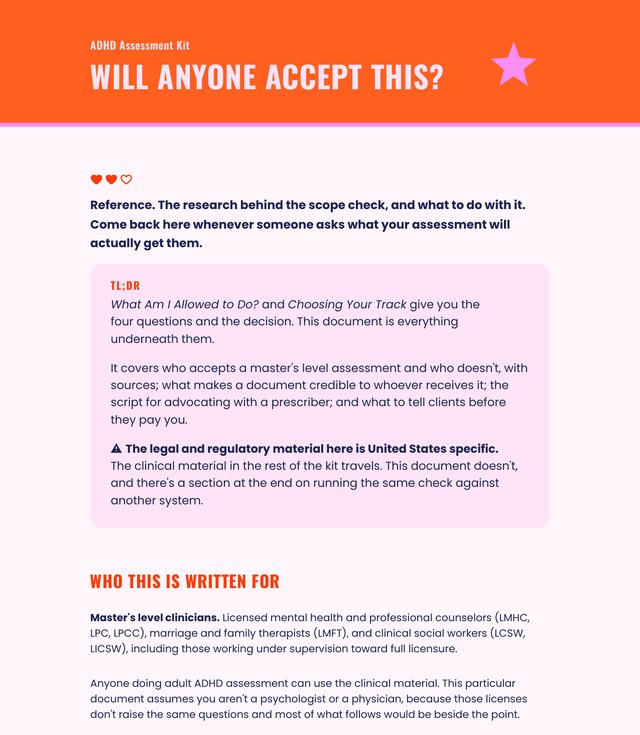
The research on who will accept a master's-level assessment and who won't, so you can be confident about your scope.
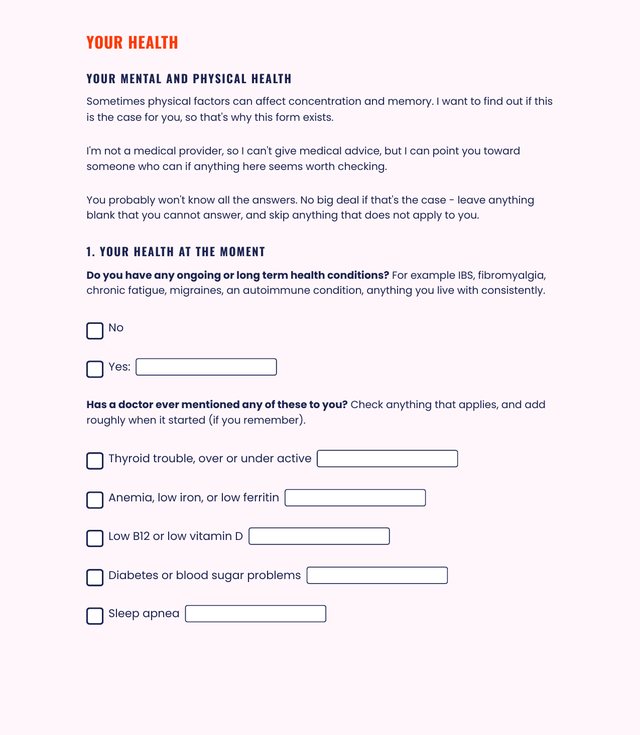
One of the custom client screeners, developed especially to cast a wide net and consider the health, hormone and developmental factors that can look a lot like ADHD.
What Am I Allowed to Do? is the very first step in the kit, and it's yours to keep. It walks you through the four questions that settle whether you can assess or diagnose where you practice, with checkboxes to tick off as the answers come back.
Read the free sample5-page PDF. No email needed.
The kit is a one-time cost, and the forms, templates and process are yours to use with every client after that.
$795
One price, or two payments of $397.50 if that's easier.
$500 to $1,500
What adult ADHD assessments commonly run per client.
1 or 2
At those typical rates, with everything already built for the ones that follow.
You'd also get to keep working with the clients you might otherwise refer out, and offer something new to the ones who are already asking. What you charge is your decision, and I can't promise what you'll earn. But the kit does include a short guide to setting your fee.
Not sure it's a fit? Email me first and we can talk it through.
$795
Or two payments of $397.50, plus applicable sales tax
Not sure it's a fit? Email me first, or read a full sample.
Whether you can diagnose ADHD depends on your license and where you practice, not on this kit. Many master's-level clinicians can run a full assessment and write a supporting letter; whether that counts as a formal diagnosis varies by state and country.
If diagnosing isn't on the table for you, the Neuroprofile Track was built for exactly that. Module 1 walks you through checking your own scope before you start.
Master's-level clinicians who want to learn ADHD assessment, especially if you want to go at your own pace but need some structure and guidance (and the dopamine hit of checking boxes along the way).
Neuropsychological testing is a quantitative assessment. A psychologist gives timed, standardized tasks and compares the scores to a reference group. This kit is built around a qualitative assessment: a structured diagnostic interview, validated screeners, history from people who know your client well, and your own clinical judgment to conceptualize and bring it all together.
Both approaches have a place, and they answer different questions. A DSM-5 diagnosis rests on a thorough clinical history and interview, and no formal testing is required. Master's-level clinicians do well here because it draws on what we already do every day: listening closely, asking follow-up questions, noticing incongruencies, and integrating information from the whole of a client's life.
Some clients will need testing, and the kit will help you recognize them early on. (For example, many universities and testing bodies only accept a neuropsychological or psychoeducational evaluation, so you'll still refer those clients out.) Workplace accommodations are a different story, since the standard there is functional limitation rather than a score, and a thorough interview-based assessment fits that need well.
Workplace accommodations, usually yes. The standard there is functional limitation rather than a diagnostic label, so a document that describes someone's consistent challenges and what would help can do the job, and that sits within a master's-level scope.
Universities and standardized testing bodies, often not. Many of them name only psychologists, neuropsychologists and physicians as acceptable evaluators, and they want psychometric data that an interview-based assessment doesn't produce.
The kit shows you how to sort this out before you book.
No, the kit doesn't come with CE hours or a certificate.
Offering CEs would have meant building the kit around a licensing board's checklist and, in most cases, hosting it on a CE platform. I chose to keep it independent so I could devote this early time and effort to making the kit as useful and badass as I could.
It also differs from most CE courses, which tend to give you the knowledge and leave the building to you. Alongside the teaching, you get the working tools: forms, trackers, consent guidance and letter templates you can drop straight into your practice.
If you need CE hours, there are plenty of ADHD courses that offer them, and several are worth taking. This kit can still be useful afterward, when you have the knowledge and still have to build the process.
Right away. As soon as you check out, you'll get an email with your login, and you can start with Module 1 immediately.
Since this is a digital product, my policy is not to offer refunds. If you're unsure whether it's a fit, email me before you buy and I'm happy to talk it through. You're also welcome to read one full document from the kit first.
That makes sense to me, because this is a real investment. If there's a question I haven't answered here, you're welcome to email me at lacey@soundmindseattle.com and I'll write back myself.
Get the kit now